
by Jacquelyn Thayer
In spring 2024, two Canadian skaters were at a crossroads. Junior ice dancer Nicholas Buelow’s partnership with Dana Sabatini-Speciale, with whom he’d competed at three Junior Grand Prix events, had come to an end, while pair skater Summer Homick, who was 2022’s national junior silver medalist with Marty Haubrich, was considering a new path. Ice dance coach Paul MacIntosh—who had worked with Homick on skating skills since she was 13, and who may be best known for his developmental work with skaters like Tessa Virtue, Scott Moir, and Andrew Poje—suggested that she consider a switch to his own discipline.

Summer Homick and Nicholas Buelow compete in the free dance at the 2025 Canadian Figure Skating Championships. Photo by Danielle Earl/Skate Canada.
Homick had, she noted, grown taller and longer-limbed, a stronger advantage in dance than in pairs. “And I don’t know, I think it was maybe just the skating skills aspect and the fact that I knew how to skate with a partner, and the holds and all that stuff,” she said of MacIntosh’s advice. She also loved the performance aspect of skating. “It was always my favorite, and even as a pairs skater, when it’s not as common—like, it’s not the main focus, as it is in ice dance—I was always performing.”
While the idea percolated, Buelow’s availability presented a sudden surprise opportunity, thanks to a little help from Homick’s pairs coach. “Alison Purkiss set up our tryout. I kind of mentioned it as a joke,” said Homick. “I knew [coach Mitch Islam] before, and I was like, Mitch has this skater, and I saw that he and his old partner split up. And I just put it up in the air because she was like, well, if you’re doing dance tryouts, you might as well do it everywhere.”
It was an experiment worth attempting.
“I think for us, the thing that came most easily was connection,” said Homick. “The first time we even had our first tryout, there was so much chemistry. We were just getting along.” More than a first tryout, it was a first meeting between the two. But, as she noted, “it all clicked together.” For Buelow, too, the pairing “just kind of seemed like a no-brainer.”
During the tryout process, the two discussed skating goals. Homick’s was ambitious. “I said, I want to get a Junior Grand Prix. And Nick was like, well, [Canada] only has seven spots, so don’t get too hung up on it if you don’t get it. And I was like, mm, I’m going to get that Junior Grand Prix.”
The two adapted easily to one another, leaving Homick to focus on the larger task of transitioning from pairs to dance. Footwork was one key difference. “We didn’t really do forward crosscuts in the other direction ever,” she said of her pairs experience. “It was just not even thought of.” Similarly, learning to twizzle—developing a mastery of both clockwise and counterclockwise rotation, and quickly switching between the two—presented the biggest technical challenge. But dance lifts, somewhat more acrobatic than their counterpart in pairs, came easily, which she credits to her fearlessness and trust in her partner.
It wasn’t merely a process of changing disciplines and partners; Homick also relocated to the Mariposa School of Skating, where Buelow had spent his career. For Homick, the most notable adjustment was leaving her smaller Brantford, Ontario, training base with Purkiss. “I’m so grateful for her,” she said. “I’ve learned a lot about how I want to be a coach from her. I feel like the biggest switch was just coming back and being with the bigger team. When I was a single skater and a pair skater, we only really had one coach, and so now I’m here at Mariposa and I have four different coaches,” including, in addition to Mitch Islam, coaches David Islam, Kelly Johnson, and James Callan.
Buelow reflected on the advantages of growing up in one school. “I think when you’re with someone for a long period of time, you really get to know each other and the coach gets to know how the skater learns,” he said. “Like I know one thing that the coaches have really learned about Summer in this last year is that she’s a very visual learner. So they’ll be like, all right, we’re going to get the video out here so that way, you can see yourself skate and the corrections that need to be done.”
One downside, of course, can be that same familiarity as a skater matures. “You are coached kind of the same way that you were coached when you were younger,” he continued. “But the coaches do a very good job of bringing in other people to get some different perspectives. And we also have a big team around us, like we have four different coaches that we’re with, and they all bring something different to the table.”
In July 2024, the team was invited to Skate Canada’s annual NextGen Competition and camp, where promising junior skaters contend for Junior Grand Prix assignments, receive official feedback, enjoy workshops on topics like movement and physiotherapy resources, and compete in team-building exercises. Their debut performance in the rhythm dance, marred by a few technical errors, put them in a disappointing 11th place out of 13 teams. “I remember I went upstairs and I was so sad, I was almost in tears, and I was like, what did I get myself into? Like, this is crazy,” said Homick. But a far stronger free dance proved their ability to regroup. “We kept our heads up, came back the next day, [and] put out an amazing free dance that even the judges, one of them said to us, I thought that you were a different team.”
The experience was a motivator. “We went back home and were really putting in that work to just get confidence and consistency in things,” said Buelow. A much-improved outing at August’s Skate Ontario Sectional Series event saw them finish second and, shortly after, earn an assignment to JGP Solidarity Cup in Gdansk, Poland. “I think we were both really happy and really proud of ourselves for achieving that and getting to that moment,” he continued.
Things trended mostly upward from there, including a fifth-place free dance performance at that Junior Grand Prix, a win at October’s Ontario Sectional competition on their home ice in Barrie, and a fifth-place finish at Skate Canada Challenge, the major qualifying event prior to Nationals. But the run-up to Nationals itself brought fresh challenges, including illness for both, with Buelow especially hard hit, and the usual holiday season obligations. “It was tough for us to bounce back after that,” said Homick. “But the way that we carried ourselves at Nationals was so, so amazing. I look back on it now and I’m like, that was, like, superhuman. I don’t know how we did that.”
Such a superhuman rally helped them finish fourth in an experienced field. “I was trying not to be like, oh, I want to get first at Nationals because, you know, sometimes that’s just unrealistic,” said Buelow. “Especially, we had some really good teams last year in Sandrine [Gauthier] and Quentin [Thieren] and Chloe [Nguyen] and Brendan [Giang],” both of whom have moved up to the senior ranks. “And obviously, Layla [Veillon] and Alex [Brandys] [are] a really good team. But I think even for kind of where I felt like I was setting realistic expectations, being sixth in Canada would have been fantastic.”
The season’s success was, in fact, Buelow’s proudest of their achievements together so far. “I think no one was really expecting that,” he said. “I honestly wasn’t expecting that myself. You know, like maybe I was just trying to keep everything kind of realistic.”
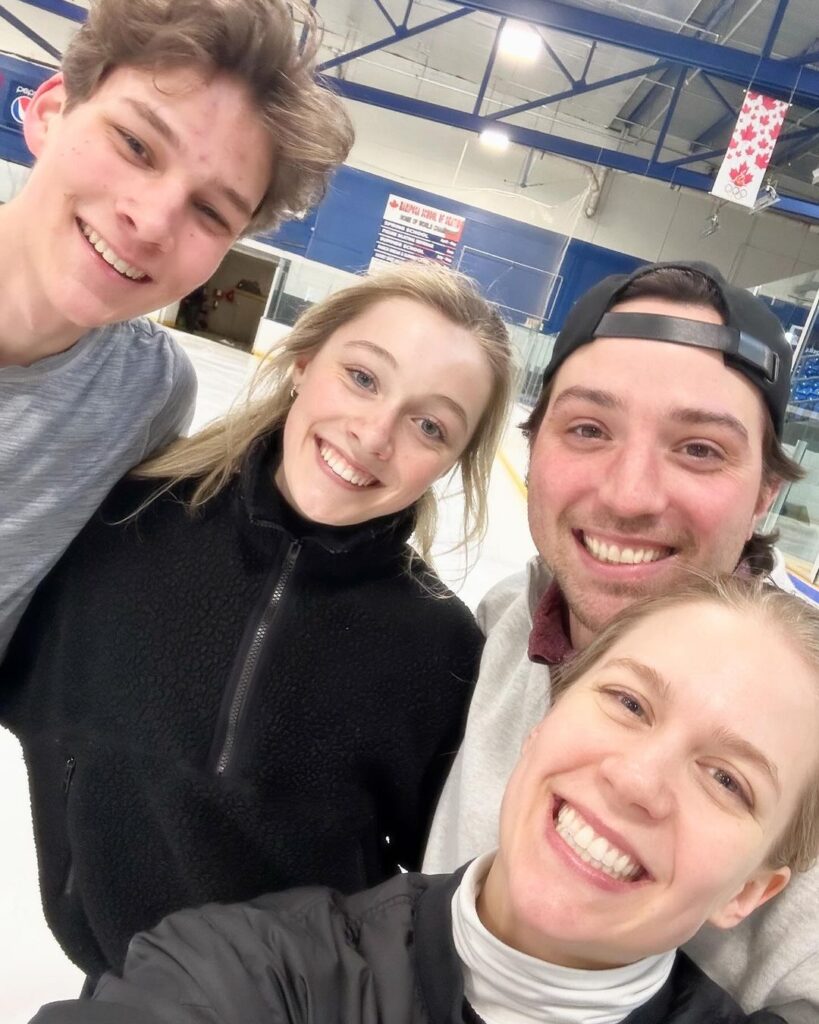
Summer Homick and Nicholas Buelow with Mitch Islam and Kaitlyn Weaver, April 2024. Photo courtesy of Mariposa Ice Dance on Instagram.
So in looking ahead to a new season, the team chose to build on last year’s success, turning again to decorated Canadian ice dancer Kaitlyn Weaver, who had choreographed last season’s well-received free dance to Sleeping at Last’s “Turning Page” with Mitch Islam. For Islam, who had often created programs with late partner and wife Alexandra Paul, the collaboration has been “truly special.”
“After losing Alex, I was afraid of what the choreography process would be like as the 2024-25 season approached. Alex and I did a lot of the choreo for my teams in years past and without her, I wasn’t sure I would have it in me,” he said. “Kaitlyn has been a very close friend for years, so when I asked her before last season if she could come help me with some choreography, with the pretext being that I was fearful of the process without having Alex, she didn’t bat an eyelash and asked when I wanted her to come. I am forever grateful for that.”
New rules from the International Skating Union around securing music rights put the team, in Homick’s words, “kind of in a kerfuffle.” A first planned choreography visit with Weaver was canceled due to initial uncertainty about their music choices; once the options seemed clear, she and Islam choreographed both rhythm and free dances in one whirlwind week.
“I think what was most frustrating was both the lack of clarity on how we were to go about securing any rights, and what was going to be required by the ISU for international competition this season,” said Islam. “I think the figure skating community understands where the rights holders are coming from; we just want to understand what the process looks like for procuring these rights. We respect that this is the way of the future, but please make it a simple process for the athletes. Finding that perfect piece is hard enough!”
While Weaver and Islam led the way, they encouraged some creative input from the skaters. “The first little bit we were, OK, let’s just put on some music, practice feeling, practice—not making up steps, but just connecting with each other, connecting with music, and really kind of letting that move you,” said Buelow. “Obviously, they were the main ones driving and making up the steps and everything. But every now and then, we would say, oh, you know, what if we did this here and that there. And we were able to make up some pretty good programs like that, I think.”
“Both last year and now this year, we’ve had an incredible time creating programs for Summer and Nick,” said Islam. “The four of us have a great rapport and energy together on the ice, and a comfortability with one another that promotes exploration and creativity. In all honesty, it’s been one of the greatest pleasures of my coaching career to learn from and work with Kaitlyn.”
This season’s rhythm dance theme, focusing on music and dance of the 1990s, afforded a plethora of possibilities. “We were listening to a million options from the ‘90s,” said Homick. “And one day we were on the ice and Mitch put on Backstreet Boys, because every single day we would come out and there would be some ‘90s playlist going on. And Backstreet Boys came on, we were all just vibing and having fun, and then we were like, oh well, I guess this is it, this is going to be the rhythm dance.”
Islam, a child of the 1990s, has appreciated the rhythm dance’s foray into millennial-familiar territory after two prior seasons of themes based on music from earlier decades. “It is certainly a new feeling to have the rhythm dance be from a generation I experienced and love,” he said. “The music, the fashion, the vibes of the ’90s, so much coolness. I’m enjoying watching this generation of athletes bring that to life on the ice.”

Summer Homick and Nicholas Buelow compete in the rhythm dance at the 2025 Skate Canada NextGen Competition. Photo by Chris Grimo.
This year’s rhythm dance has also introduced a new twist: teams are required to do one segment apiece of the rhumba and quickstep pattern dances, rather than two segments of a single pattern. Though pattern dances are still new for Homick, the two agree they love the challenge it presents. Off-ice hip hop classes have helped their comfort level with the program’s boy band-styled movement to “Larger Than Life” and “Everybody (Backstreet’s Back).”
The outgoing rhythm dance contrasts strongly with a softer contemporary free dance to selections from Ghost, the 2011 musical adaptation of the 1990 film. “The free dance is, I would say, our strength, and we did kind of want it to be that way,” said Buelow. “We had really good success with our free dance from last year, so we wanted to keep down that route of your classic love story. And this year, it is a little bit different because, obviously, it’s Ghost, so I’m dead by the end of the program. But it keeps that similar theme.”
The free dance concludes with a unique choreographic sliding movement—a death spiral, inspired by a suggestion from Weaver during last year’s choreo sessions. “She said to us, what’s something cool that you can do that’s like a pair skater move or a single skater move that other people can’t?” said Homick. They settled on the death spiral, but found it didn’t mesh with last season’s free dance music. This year, they made it work.
Their second season has gotten off to a strong start with a silver at their second NextGen Competition—not to mention victory in a head-to-head twizzle battle in the NextGen team event. Even before the camp, they received one of Canada’s first dance assignments for this year’s Junior Grand Prix, slotted for the third event in Varese, Italy. And in early August, they were announced as the junior dance recipients of the 2025 Toller Cranston Award for Canadian juniors and novices. “Toller’s artistry and fearless creativity has always inspired us, and being recognized by his name is something we will carry with pride throughout our skating journey,” they said in a follow-up.
A week after NextGen, Weaver paid another visit to Mariposa, helping the team with touch-ups and technical refinement. This remains their focus heading into their next competitions, including this August’s Ontario Sectionals. “It is hard. It’s not easy to get those key points,” said Homick. “But I think it’s technical and a lot of cleaning up, like I feel like that was our biggest takeaway from that event. It’s just tidy little areas, but they all add up.”
And when off the ice, the team has a packed schedule of strength training, ballet, hip hop, and flexibility. Both skaters are recent high school graduates, focusing for now on their athletic pursuits, with Homick planning to continue her studies next year and Buelow looking toward grade 13 to complete a few extra credits. For Homick, who lives away from home, the gap year is also an opportunity to see family.
In the longer term, the team is focused on growth across the board. “Always, I guess, you’re trying to improve technical, and you’re always trying to improve speed and flow across the ice, and your deepness and your turns and your edges,” said Homick. “Of course, connection comes well for us, but we’re always still working on getting everything better.”
Last season, the team was additionally motivated by training alongside fellow Canadian juniors Rachel Martins and Juel Kowalczyk. Though that pair has since split, Homick and Buelow haven’t lacked for daily inspiration from other sources.
“We’re fortunate, too, that we have Mitch on our coaching staff—all of our coaches, in fact, and they’re all so passionate about what we do,” said Homick. “So of course right now, there’s not a lot of teams on the ice with us, but it’s still so motivating being in the hands of Mitch and David and Kelly and Kaitlyn when she comes, too, which is such a blessing.”
Buelow agreed. “Yeah, and I feel like we’ve also gotten better at just kind of motivating each other and trying to push each other to be better.”
And while the team appreciates Islam’s competitive experience, his coaching style provides a more immediate benefit. “He brings a lot of energy to the rink in the morning as well, which you need when you’re starting at 6:30 some days,” said Buelow with a laugh.
Islam, for his part, thinks “the sky’s the limit” for his team. “They are both natural feelers and performers and have the innate ability to make you want to stop and just watch,” he said. “Watching Summer’s foray into ice dance and her rapid development has been particularly inspiring. Sometimes I remember that she’s only been dancing for a little over a year and I have to give my head a shake. Summer and Nick are hard workers and they have a wonderful rapport and working relationship. They’re good people and that goes a long way in this discipline. I am really looking forward to watching them attack their way forward.”