
by Jacquelyn Thayer
On September 15, Skate Canada took to social media to announce its assignments for Skate Canada International, the second stop on the 2026 Grand Prix series. Among the entries were up-and-coming Canadian ice dance team Alyssa Robinson and Jacob Portz who, as it happened, had only learned the news themselves an hour or two before.
“We got the emails, like the official invite, on our first [skating] session,” said Portz. “And then just towards the end of our second session, I noticed Alyssa was getting tagged in a bunch of Instagram posts, or she kept getting notifications. So I tapped on, and it went ‘Skate Canada tagged you in a post.’ And it was like, ah, all right. We haven’t told anyone yet.”
While most skaters receive Grand Prix assignments based on their results at the previous season’s world championships, or courtesy of a high placement in the sport’s world rankings, additional athletes can be selected as host picks if they represent one of the six Grand Prix host countries. Skate Canada, as one such federation, had left its ice dance pick open when Grand Prix entries were first announced in mid-June.
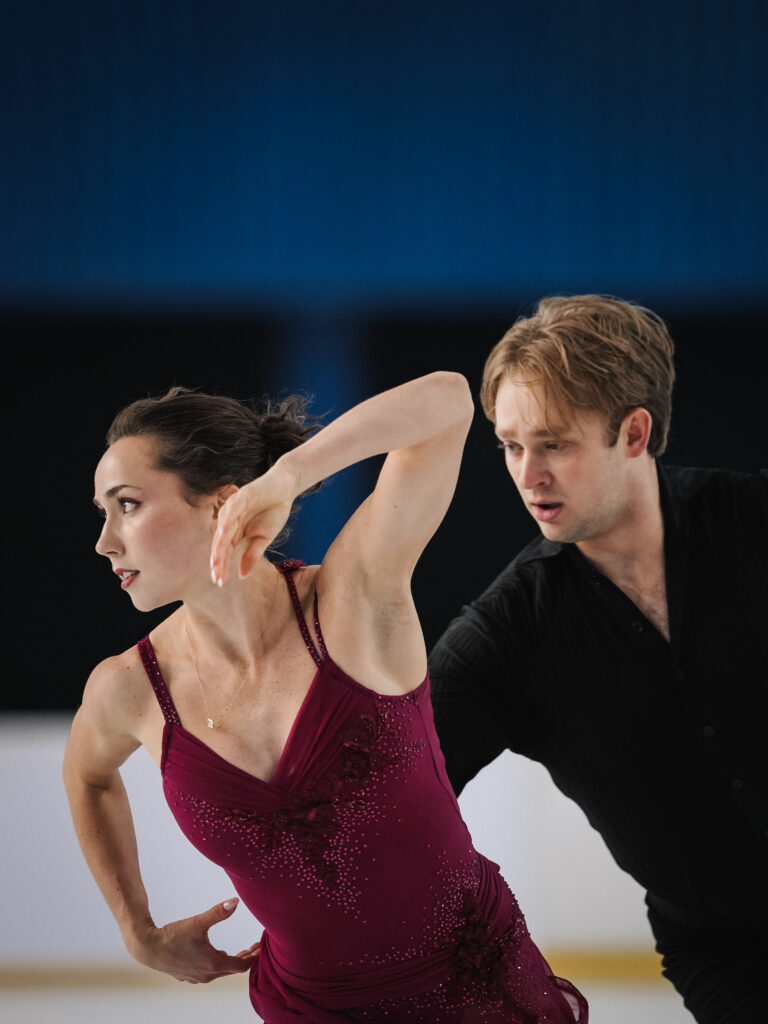
Alyssa Robinson and Jacob Portz compete in the free dance at 2026 Trialeti Trophy. Photo by Iana Saveleva.
This was understandable. After March’s World Figure Skating Championships, four of Canada’s top 10 senior ice dance teams had split and reconfigured into four new pairings, three of whom were internationally eligible to compete in the fall. But this shake-up also left Robinson and Portz, who had placed fifth at the 2026 Canadian National Skating Championships, as one of the more veteran teams in their field, despite limited international experience. While their domestic results were good, and improving by the season, the depth of the Canadian ice dance scene had made access to assignments competitive. The team had so far only been sent to a few smaller international competitions as seniors, and one Junior Grand Prix event back in 2021.
A handful of domestic events in August were critical. “We knew that we would be in the running,” said Portz. “A big goal for us was to have two good summer competitions. They didn’t need to be perfect skates, but we wanted, and I’m sure Skate Canada wanted, to see us go out, compete hard, and show the improvement that came from last season.”
They made their season debut at the Quebec Summer Championships in early August, recovering after an error in the rhythm dance to place first in the free dance and third overall. A win at Skate Ontario’s August Sectional Series event one week later impressed Skate Canada’s high-performance director, Mike Slipchuk.
“After the August Sectional Series in Waterloo, we had a brief chat with Mike in the lobby, and he was saying that, hey, you guys look good this summer. You had two good competitions,” said Portz. “So we didn’t know that we’d be getting Skate Canada at all. We kind of picked up that we’d be getting some kind of Challenger. From the way Mike was saying [it], it’s like, hey, what do we think he’s saying here? And we found out a couple of weeks later that we’d be getting [Trialeti Trophy in] Georgia. And then it was Tuesday that we got the e-mail when we were on the ice. We’d had a few good conversations with the coaches because we knew that the spot was open, that there’s a chance we’d get it. So we kept asking. They’re like, just focus on Georgia, focus on training right now.”
“One of our biggest goals was to come into the summer being really ready and prepared,” said Robinson. “I feel like we really did that. And even Mike said this is the most prepared he’s seen us at the start of the season. So that was a goal of ours that we feel we accomplished. They weren’t perfect skates, but we really went for it.”
It’s a milestone for two athletes who’ve spent most of their lives on the ice. Robinson started skating around age four, inspired by family. “I have an older sister, and I always would watch her skate,” she said. “So I really wanted to skate as well to be like her. And my family is pretty big into figure skating as well, with my mom and my grandma.” Robinson moved into ice dance as a young teen, training in Barrie, Ontario, and competing at the pre-novice and novice levels with Joshua Andari.
Portz, whose mother Chantelle coaches in Calgary, has skated “for as along as I can remember.” He and older brother Davin, who competed internationally in pairs for Canada, began skating for practical reasons: hockey. “But my mom’s rule for us playing hockey was if we played hockey, we had to figure skate to learn how to skate properly, because we were not very big kids growing up,” he said. “And so once you get into the hitting leagues, we would not make it very long. And when we moved from small-town [Alberta] to Calgary, ice was just too expensive for both. So I stuck with figure skating.” With partner Isabel McQuilkin, Portz would earn 2019 novice national bronze, as well as a Junior Grand Prix assignment later that year.
In 2020, with their previous partnerships ended, Robinson and Portz tried out together in Calgary. “I think we both kind of just knew, ‘this is my partner,’” said Robinson. “We had a lot of fun.” The two trained at the Caltalta Figure Skating Club through 2022, until Robinson’s acceptance to the University of Western Ontario, where she now studies health science, inspired a change of scenery. A personal link between the Alberta section’s former technical director, Holly Henderson, and the famed Moir coaching family opened a door to the London, Ontario, campus of the Ice Academy of Montreal, led by Scott Moir.
“She had sent a text on our behalf saying that there was a team that was thinking of moving to London just for school and if they’d be open to having us do like a tryout of sorts and interview,” said Portz. “So I think it was a couple of days after Holly sent that text, we had a Zoom meeting with Scott, Madi [Hubbell], and Adrián [Diaz]. And then two or three weeks later, I was on a road trip from Calgary and Alyssa was flying back with all of her stuff.”
Relocating to London meant training under a young and rather accomplished coaching team, led by six-time Olympic and world champion Moir, six-time Olympic and world medalist Hubbell, and eight-time Spanish national champion Diaz. And while the school has grown since the two arrived four years ago, the system runs smoothly. Teams have access to eight to 10 hours of ice time across the school’s different rinks, while a scheduling app logs each athlete’s availability for any given training time.
“All the coaches are great,” said Portz. “I feel like each coach has their own—not specialty, but there are certain coaches, like if you need a lift lesson, you’re going with one coach; you’re doing more of a balletic waltz, you’re going with another coach. We bring our ballet teacher out to the ice, try and get us a little bit more focused training.”
“It really does feel like a team atmosphere, too,” added Robinson. “I would say we all really cheer each other on like we’re in each other’s corners. So that’s really fun about where we train as well. For example, when everyone is doing run-throughs, we all clap each other on. And the coaches are really supportive here. It’s pretty great.”
Even the process of element creation—like the aforementioned lifts—is often a team effort. “All of the coaches contribute to lifts in different ways,” said Robinson. “Scott and Adrián are really great at envisioning and creating new lifts off ice, and they help us to bring our ideas onto the ice in the beginning stages. During the summer, Scott and Adrián also lead group lift sessions off the ice where we work on lifting exercises and fundamentals. All of the coaches provide great input throughout the season; however, we work with Scott, Adrián, and Justin [Trojek] most frequently on lifts.”
Off-ice work typically includes two ballet classes per week with Kelly Noorloos, a graduate of the Kirov Academy of Ballet and alum of companies in North Carolina and Turin, Italy, as well as periodic yoga sessions to “decompress” at the end of a week or two of training. Mental prep, too, is a focus, with Portz crediting the team’s improved competitive mindset to their work with performance coach Steffany Hanlen. More general athletic and strength training might depend on the skater’s needs. “The coaches are involved with each of the trainers and getting a training plan, just seeing how we’re doing, but it’s really up to us to find a trainer that works for us that we kind of bond with,” he said. “A lot of the skaters are starting to work with EPIC, the hockey academy, but they have a gym attached to the rink. The physio center is there. So it’s super easy for us to go and get treatment, have a workout in between skating, anything like that. Trainers are super great about coming down to the rink to watch us skate, walk us through some warmups.”
The start of a new Olympic quadrennial in skating has meant a fresh set of rules in ice dance, including a revamped rhythm dance. For the first time since the 2021-22 season, seniors are required to skate a segment of a pattern dance within that program. This year, it’s the legendarily challenging Golden Waltz, created in 1987 by Marina Klimova, Sergei Ponomarenko, and Natalia Dubova. That particular pattern was last skated in international competition in 2010-11, when it was included in that season’s senior short dance; no skater competing on the Grand Prix this season was on the senior circuit at the time.
News of the upcoming season’s pattern broke on February 16. A day or two later, I.AMO teams got to work. “We were in stroking [lessons] and [Adrián]’s like, all right, we’re all learning the Golden Waltz,” said Portz. “It’s been a lot of fun doing it. It was definitely a challenging dance to learn and get the small details, especially with the increase of speed. And needing proper edges for a key point is a bit of a change from when we learned it—we didn’t know the key points or where they would be. So it’s like, all right, we’re just going to do a regular Golden. So that change was something to focus on for sure.”
Happily for I.AMO students, Hubbell, Diaz, and Moir—whose 2010 Golden Waltz compulsory dance with partner Tessa Virtue at the 2010 world championships went viral earlier this year as the pattern’s Platonic ideal—all have experience competing the dance. “Each of them have different little tips and tricks for timing or making the steps more clear,” said Robinson. “And sometimes the timing’s a little bit fast, so it’s really helpful that they’re so knowledgeable about it.”
With the Golden Waltz’s intricate footwork demands have come equally stringent tempo and style requirements. The pattern is similar to the fast-paced Viennese waltz in ballroom, meaning that some music in 3/4 time may be too slow. Nor can a team only use music in 3/4 time; the official rhythm dance theme is “rhythm and waltz,” meaning programs must feature at least one distinctive non-waltz rhythm.
“The rhythm dance, we were kind of stuck with the Golden Waltz and coming up with a waltz that we liked,” said Portz. “We’d had some ideas, but nothing was really working, whether it was timing of the music, theme, stuff like that. Adrián had suggested doing The Artist. And I was a big fan of it because I’ve always liked the sillier programs, more like the character-driven programs. I find it easier to get into.”
Hubbell took charge of choreographing the rhythm dance to selections from that 2011 film’s score, while their soulful free dance choice of Donny Hathaway’s “A Song for You”—a piece they’d had in mind for years—inspired another coach.
“In the offseason, Scott will put our playlist on and then have us go and just skate to it, like whatever we feel,” said Robinson. “So I think he really liked the way we were moving to it, and that really stuck for us. So Scott choreographed our free dance this year, which he’s taken a step back from choreo for the past couple of years, so it was really, really fun to work with him on program creation this year. That was pretty cool.”
And the team got a bonus assist when Virtue stopped by the I.AMO campus in the offseason. “It was pretty amazing,” said Robinson. “I mean, I feel like all of us skaters look up to her, so that was really special. We had a lesson with her and Scott on our free dance together, and she had some little cues and some advice for different parts of our program. So it was really fun to work with both of them together as well. That was special.”
The sprightly old Hollywood-inspired rhythm dance and contemplative free dance play to the strengths of both partners. “I feel like separately, we have different styles,” said Robinson. “Jake likes doing character pieces and being very performative, and then I’m a bit more of an introverted performer. So together, I think we balance each other really well in that way. But I feel like something we’re good at is connecting to each other in our performances, so I think that’s something we lean into a lot.”
“Yeah, I’ve always loved the really fun programs,” agreed Portz, noting his influence on past rhythm dance choices like Flashdance in the 2023-24 season and, in particular, the Red Hot Chili Peppers last season. “That was a big win for me, suggesting that to Alyssa and the coaching team, and they go, yeah, that sounds like a good idea,” he said.
“Madi, Scott, also Cara [Moir]—they all love Chili Peppers, so they were pretty pumped to create that program for us,” said Robinson. “I was a bit hesitant at first. That was something that was a bit outside my comfort zone, but it ended up being so much fun. And I think last year’s programs were a bit of breakthrough programs for us. So yeah, that was a good year.”
Last season’s free dance, choreographed by Cara Moir, balanced the edginess of their rock rhythm dance. “We originally had a different concept in mind for our free dance, but Adrián suggested exploring the music from W.E., and we immediately fell in love with it,” said Robinson. “Our coaches also felt that the music would be a great fit for us and that it offered a lot of potential for growth in our skating. We were especially drawn to the opportunity to portray the characters of Wallis and Edward and to capture the romance and elegance of their love story on the ice. The idea evolved into a program that both of us really loved and gave us the opportunity to explore a different style of storytelling as a team.”
I.AMO’s sense of continuity extends beyond choreography and technique coaching. Eagle-eyed fans have spotted the reuse of familiar costumes over the years, as skaters and coaches alike are happy to share with their training mates or students as needed. For their summer competitions, Robinson sported dresses worn first by Virtue at the 2014 Canadian national championships and by training mate Christina Carreira in the 2022-23 season. One I.AMO coach—and Moir cousin—has played keeper of the wardrobe.
“Cara, I think, has a lot of Tessa’s old dresses,” she said. “So we’ll typically go to Cara and ask her, ‘Oh, do you have any dresses that might go with this program? Ours won’t be ready in time, just with the whole process.’” And Scott Moir’s old costumes are on reserve, too—Portz has, on occasion, sported shirts of his, also maintained by Cara Moir.
Training in London has provided the team with an opportunity to learn directly from the greats they admired growing up. “I think back to when I was a kid and when I would watch, like, Tessa and Scott and Madi and Zach [Donohue], and even like Maddie [Chock] and Evan [Bates], I was so inspired, and I remember that feeling watching those top teams like, oh, I want to do that,” said Robinson. “I think getting inspiration from that, as well as remembering why I started and that little girl that started skating, like making those dreams come true. That’s a big factor for me.”
Though Portz had fewer major skating role models growing up, he also singles out Virtue and Moir, along with Andrew Poje, three-time world medalist and Canadian champion with Kaitlyn Weaver. One year, he noted, “my mom was watching the ice dance event, and I just thought the way that Andrew skated looked like really nice skating. And I wished I was, A, as tall as him and, B, had as nice hair. But I guess I could say that about Scott’s hair, too. His hair is pretty good.”
Family, though, has been a primary inspiration. “My older brother, when I was younger, I was always trying to catch him,” said Portz. “But the last couple of years, it’s been my mom, thinking more about why she put us into skating and why she loves skating, and then being able to put my own point of view into it.” And the loss of his father in November 2023 has added poignant new meaning. “With my dad passing away, being able to not open up a bubble, but be able to actually skate for me and feel whatever emotions I’m feeling,” he continued. “It feels easier to portray it on the ice, which is an unfortunate way to be able to portray it on the ice, but something that’s helped me enjoy a little bit more and have a purpose behind it.”
Like many competitors, both Robinson and Portz now share their knowledge with the next generation as part-time coaches, Portz also offering his services as a dance partner. “It’s helped me with my skating, kind of breaking it down, but it’s just been fun to be able to help younger skaters,” said Portz. “I work part-time at SportChek, but really, my life is skating and work. Trying to get outdoors when I can, go hiking or camping or fishing.”
“Last year, I did my first competition as a coach with some of my students, which was a lot of fun,” said Robinson. “It really gives some perspective to be on the other side like that. I’ve been learning how to sew recently, so I’m hoping to really work on that this year. It’s kind of a side hobby.”
The team’s international season began at Trialeti Trophy in Batumi, Georgia, in early October, where they set new ISU personal best scores in all categories and finished 10th overall. With Skate Canada International up ahead in late October, their competitive philosophy is focused less on results than on the effort they’re putting in.
“I think our goals are just to continue what we’ve been doing with the end of last season, the start of this season, of just keep having solid skates, focusing on what we can control,” said Portz. “Placements are, I think for us, a great thing to focus on, but recently, it hasn’t been what’s kind of gotten us to where we’ve been comfortable with skating. We’ve just been focusing on competing the way we train, bringing every cue to the ice, and it’s been working out for us. So I think we’re just going to try and keep that going.”